
The Professional Amateur: My Unexpected Journey Into Pickleball
There is something deeply addictive about being a beginner again.
Not the polished confidence that comes from years of repetition, nor the comfort of muscle memory built over thousands of hours on court, but the awkward, exhilarating uncertainty of learning something entirely new. The missed timings. The accidental winners. The moments where instinct betrays you because your body is still trying to understand the language of a different sport.
That feeling is precisely why I’ve decided to begin a new series called The Professional Amateur.
The idea behind it is simple: how many sports can one reasonably train at the same time while still reaching a genuinely respectable level? Not professional, of course — that ship sailed long ago for most of us — but good enough to understand the intricacies of the sport, appreciate its culture, and feel the quiet satisfaction that comes from progression.
For the last few years, padel has consumed much of my sporting life. What began as curiosity evolved into obsession. Endless evenings at Rocket Padel Battersea became part of my weekly rhythm, and somewhere along the way I rediscovered the joy of racket sports entirely.
Tennis had always been there in the background too, woven deeply into my sporting DNA from childhood, but padel reignited something in me — a desire not just to play, but to study movement, equipment, tactics, psychology, and the beautiful subtleties that separate decent players from exceptional ones.
And then came pickleball.
Now, if you’re reading this from the United States, you’re probably wondering what took us in Britain so long.
Across America, pickleball has exploded into a cultural phenomenon. Retired athletes, former tennis players, complete beginners, celebrities, entrepreneurs — everyone seems to be playing it. Courts are appearing everywhere. Major League Pickleball is attracting serious investment. Tennis clubs are converting space. Equipment brands are pouring millions into development. What once looked like a quirky hybrid pastime has rapidly become one of the fastest-growing sports in the world.

But here in the UK, pickleball still feels wonderfully underground.
Mention it to most people and you’ll often receive a confused expression, followed by some variation of: “Isn’t that just mini tennis?”
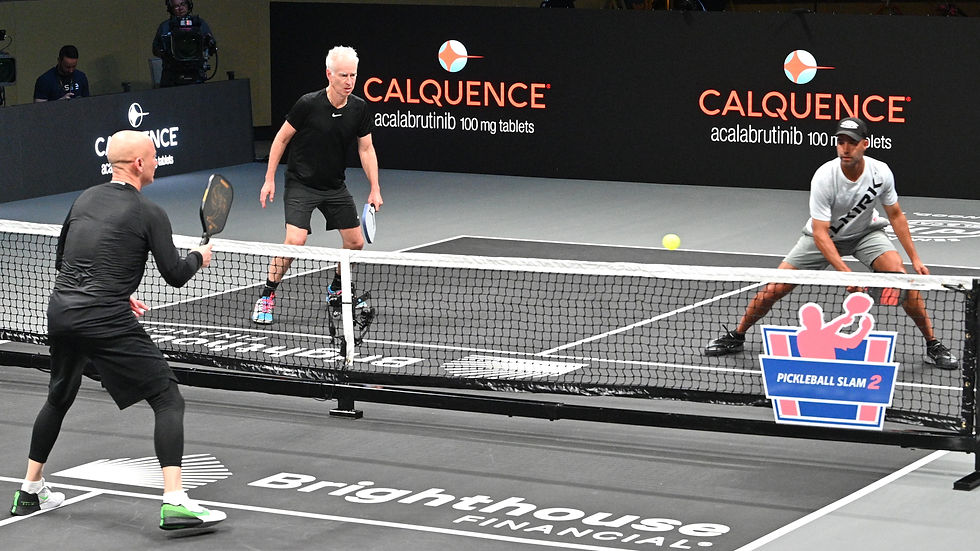
Having now spent time properly playing it, I can confidently say that it absolutely is not.
Yes, from a distance it appears deceptively simple. The court is smaller. The paddle is solid. The ball looks like something you’d find in a school PE cupboard. But the moment you start playing seriously, you realise there is an extraordinary amount happening beneath the surface.
The first thing that struck me was the speed of improvement.
Unlike tennis, which can punish beginners brutally, pickleball offers immediate enjoyment. Rallies happen quickly. Points feel competitive almost instantly. You can arrive as a competent tennis or padel player and within a few sessions already feel tactically engaged. But then, just as you begin to think you’ve figured it out, the sport reveals layers of complexity.
The soft game.
The transition zone.
The famous kitchen.
The hand speed battles.
The cat-and-mouse exchanges at the net.
It becomes less about brute force and more about geometry, patience, positioning, and reaction time. In many ways, it feels like a fascinating blend of tennis instincts and padel creativity. Tennis gives you the mechanics and explosiveness; padel gives you the touch, angles, and comfort in close-quarter exchanges.
What surprised me most, however, was just how perfectly pickleball fit into my wider sporting routine.

I initially approached it as an experiment. A curiosity. Something to explore for a few weeks before inevitably returning full-time to padel and tennis. Instead, it has slotted itself naturally into my week. The shorter court means less physical strain than a full tennis session, while still delivering fantastic movement and cardio. The reflex exchanges sharpen your hands tremendously. The strategic nature of the sport keeps your mind engaged constantly.
In truth, I’ve found that pickleball has actually improved certain aspects of my padel game.
My reaction speed at the net feels quicker. My ability to absorb pace has improved. My touch shots feel softer and more intentional. There’s a patience to pickleball that forces you to construct points carefully rather than simply overpowering opponents.
And then there is the equipment.
Naturally, this is where things became dangerous for me.
Anyone who has followed my sporting journey knows I become mildly obsessive about rackets, paddles, engineering, and innovation. I love understanding why certain equipment works. Why some pieces of technology feel transformative while others feel entirely marketing-driven.
Which brings me to the Adidas Metalbone LP 16mm pickleball paddle.
I’ll say this plainly: this paddle completely changed my perception of what pickleball equipment could feel like.
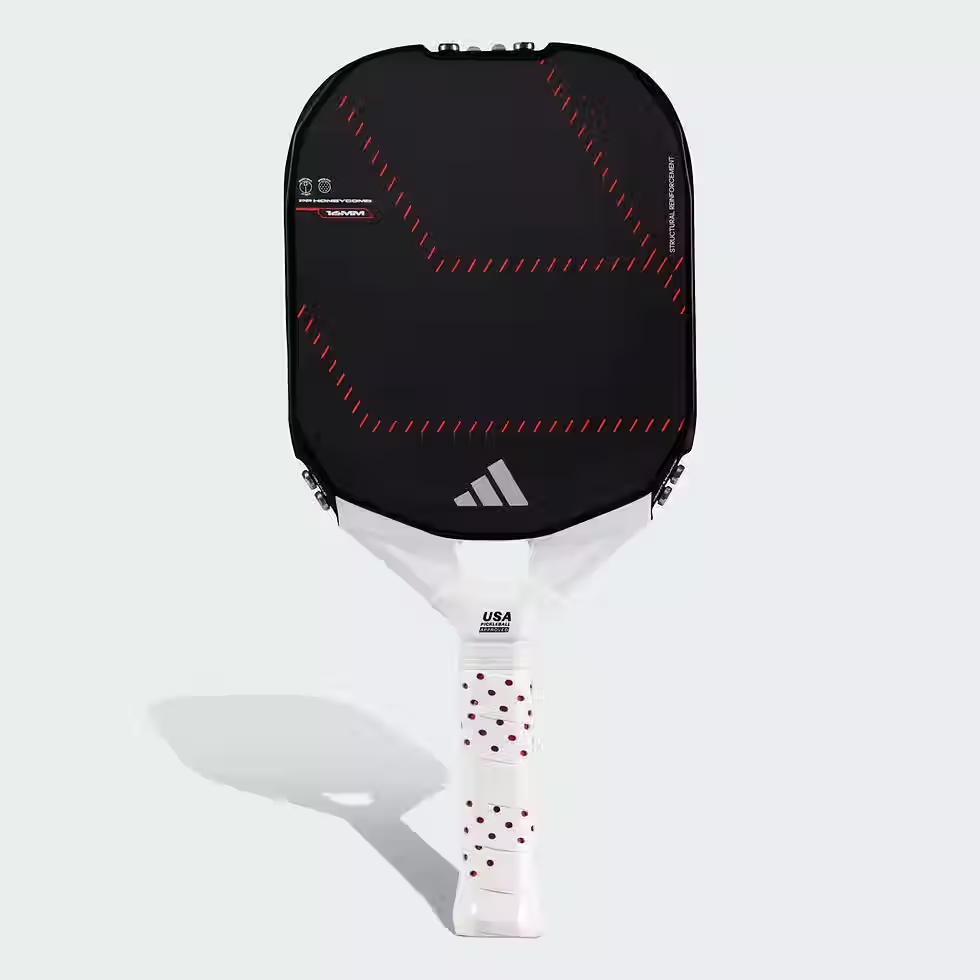
The first time I used it, I immediately understood that Adidas is approaching pickleball with the same seriousness and innovation that has made the Metalbone range such a success in padel.
And it makes complete sense.
This is not a brand experimenting casually with emerging trends. Adidas understands racket sports deeply. Their history within tennis alone gives them enormous credibility, but what impresses me most is how intelligently they’re adapting that expertise into newer sports categories.

The Metalbone 16mm feels purposeful.
Everything about it feels engineered rather than assembled.
The first thing you notice is the power.
Not uncontrolled, wild power — but heavy, penetrating power that somehow still feels manageable. Coming from padel, I naturally enjoy dictating rallies with aggression when the opportunity presents itself, and the Metalbone rewards that mentality beautifully. Drives explode off the face with satisfying depth, while overhead put-aways carry genuine authority.
Yet what impressed me even more was the precision.
Often in racket sports, equipment that delivers huge power can feel erratic or overly lively. The Metalbone somehow manages to combine explosiveness with an incredibly stable, confident response. Dinks feel controlled. Blocks stay compact. Resets land softly. And when the opportunity arrives to accelerate through the ball, the paddle responds instantly.
It’s the sort of equipment that encourages ambition.
You begin attempting shots you might normally avoid because the paddle gives you confidence that it can execute them.
And visually, it’s stunning.
Adidas has always understood the emotional importance of design in sport. Athletes want equipment that performs brilliantly, yes, but they also want to feel inspired every time they pick it up. The Metalbone 16mm carries that same aggressive sophistication that I loved in the Metalbone CTRL padel racket. Sleek lines, bold detailing, and a premium finish combine to create something that feels unmistakably elite.
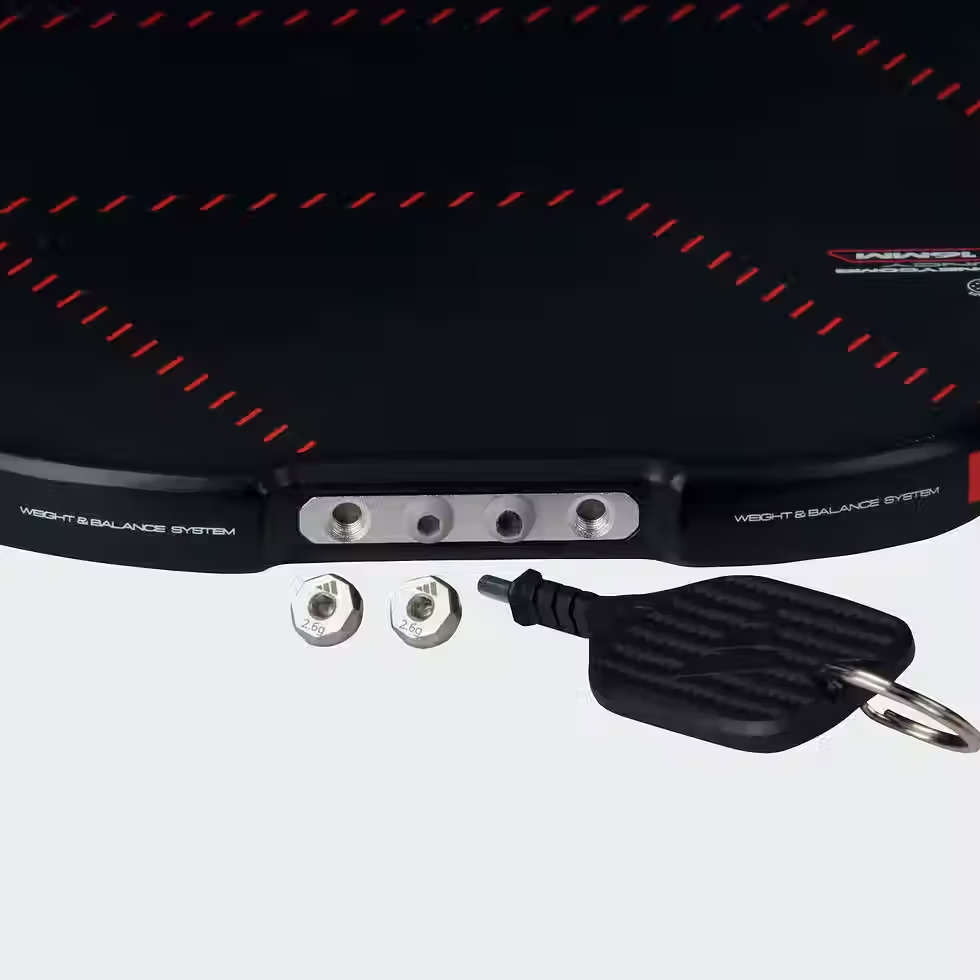
There’s also something deeply satisfying about seeing Adidas fully commit themselves to the pickleball space.
Many legacy brands have approached pickleball cautiously, almost nervously, unsure whether the sport represents a genuine long-term opportunity or simply a passing trend. Adidas, however, seems to understand what many others are beginning to realise: pickleball is not replacing tennis or padel — it’s complementing them.
And that distinction matters.
I don’t see pickleball as competition for the sports I already love.
I see it as another language within the same conversation.
Some evenings I want the physicality and tactical complexity of padel. Other days I crave the elegance and rhythm of tennis. Increasingly, however, there are moments where pickleball feels exactly right — social, fast-paced, technical, addictive, and surprisingly nuanced.
What fascinates me most is how these sports now influence one another in my own development.
Padel has improved my touch in pickleball.
Pickleball has sharpened my reflexes for padel.
Tennis continues to provide the foundational mechanics and movement patterns underpinning everything else.
Rather than competing for my attention, they’re enhancing one another.
That, perhaps, is the central discovery of The Professional Amateur so far.
You do not necessarily need to specialise entirely in one discipline to experience meaningful progression. There is enormous value in cross-training between complementary sports, particularly when each one teaches your body and mind different skills.
And perhaps more importantly, there is joy in remaining curious.
In adulthood, many of us stop learning new physical skills altogether. We become protective of competence. We avoid situations where we might look inexperienced. But there’s something incredibly energising about entering a new sporting environment, asking questions, making mistakes, and slowly improving.
Pickleball has reminded me of that.
It has reminded me how exciting it is to start from the beginning.
So while the sport may still be quietly emerging here in the UK, I have absolutely no doubt that its moment is coming. Once people experience the accessibility, the tactical depth, and the sheer fun of it, growth feels inevitable.
And as for me?
I’ll continue balancing this strange sporting triangle of tennis, padel, and pickleball, chasing incremental improvements while probably acquiring far too much equipment along the way.
The Professional Amateur journey has officially begun.
And honestly, I’m enjoying every second of it.


Mình có lần lướt đọc mấy trao đổi trên mạng شيخ روحاني thì thấy nhắc nên cũng tò mò mở ra xem thử cho biết. Mình không tìm hiểu sâu جلب الحبيب chỉ xem qua trong thời gian ngắn để quan sát bố cục جلب الحبيب cách sắp xếp شيخ روحاني các mục và trình bày nội شيخ روحاني dung tổng thể. Cảm giác là các phần được trình bày khá gọn, các Berlinintim mục rõ ràng nên đọc lướt cũng không bị rối Berlinintim với mình như شيخ روحاني vậy là đủ để nắm tin cơ bản rồi. جلب الحبيب
😍
The concept of The Professional Amateur is really exciting. A lot of adults quietly abandon the idea of getting genuinely good at a sport because the only options seem to be 'casual player' or 'serious competitor' - but neither fits. I love how you've forged a third path here: we can invest properly, learn with intention and pursue real progress, but purely for the love of the sport. This series could really encourage a lot of people back into sport who've been sitting on the fence, unsure whether their level of interest 'counts' as enough to justify taking it seriously. If you're ever interested in venturing beyond racket sports, I wonder if you'd ever give kickboxing a try!
Franchement, j’avais juste besoin d’un moyen simple pour **telecharger reels instagram** sans installer quoi que ce soit sur mon téléphone. Après avoir testé plusieurs sites, j’en ai trouvé un qui fonctionne correctement et le téléchargement est assez rapide.
Il suffit de copier le lien du Reel Instagram puis de le coller sur le site, et la vidéo se sauvegarde sans problème. Ça m’aide surtout pour garder des vidéos utiles ou drôles à regarder plus tard hors ligne.